When I was in high school biology, my teacher said brown eyes are dominant and blue eyes are recessive, so two brown-eyed parents can't have blue-eyed kids. Then my aunt—who has brown eyes—had three blue-eyed children with her brown-eyed husband. So much for that rule, right?
Turns out, dominant and recessive traits aren't as simple as "one always wins." The reality is way more nuanced, especially when multiple genes are involved. But understanding the basic concept is still super useful for making sense of how traits get passed down through families.
What Does "Dominant" Actually Mean?
In genetics, a dominant trait is one that shows up in your physical appearance (your phenotype) even if you only have one copy of the gene variant (allele) responsible for it. You get two copies of most genes—one from each parent. If one copy is enough to express the trait, that trait is dominant.
Example: Let's say you inherit a "brown eyes" gene from your mom and a "blue eyes" gene from your dad. Since brown is dominant, your eyes will be brown. The blue gene is still there in your DNA—it's just not visible.
Recessive Traits: Both Copies Required
A recessive trait only shows up if you inherit two copies of the recessive allele—one from each parent. If you have one dominant and one recessive allele, the dominant one "masks" the recessive one.
Using the eye color example: blue eyes are recessive. To have blue eyes, you need two copies of the "blue" allele (one from each parent). If you have one "brown" and one "blue" allele, you'll have brown eyes—but you're a carrier for blue eyes and can pass it to your kids.
Dominant: Expressed with just one copy of the allele.
Recessive: Requires two copies of the allele to be expressed.
Common Examples of Dominant vs Recessive Traits
Here are some classic examples genetics textbooks love to use. Keep in mind that real-world genetics is often more complex than these simple single-gene models.
| Trait | Dominant | Recessive |
|---|---|---|
| Hairline | Widow's peak | Straight hairline |
| Earlobes | Free (detached) | Attached |
| Tongue rolling | Can roll tongue | Cannot roll tongue |
| Dimples | Has dimples | No dimples |
| Hair texture | Curly hair | Straight hair |
| Freckles | Has freckles | No freckles |
But here's the catch: most traits listed above are actually influenced by multiple genes, not just one. The dominant/recessive model works best for true single-gene traits, which are rarer than you'd think.
Why Two Brown-Eyed Parents Can Have Blue-Eyed Kids
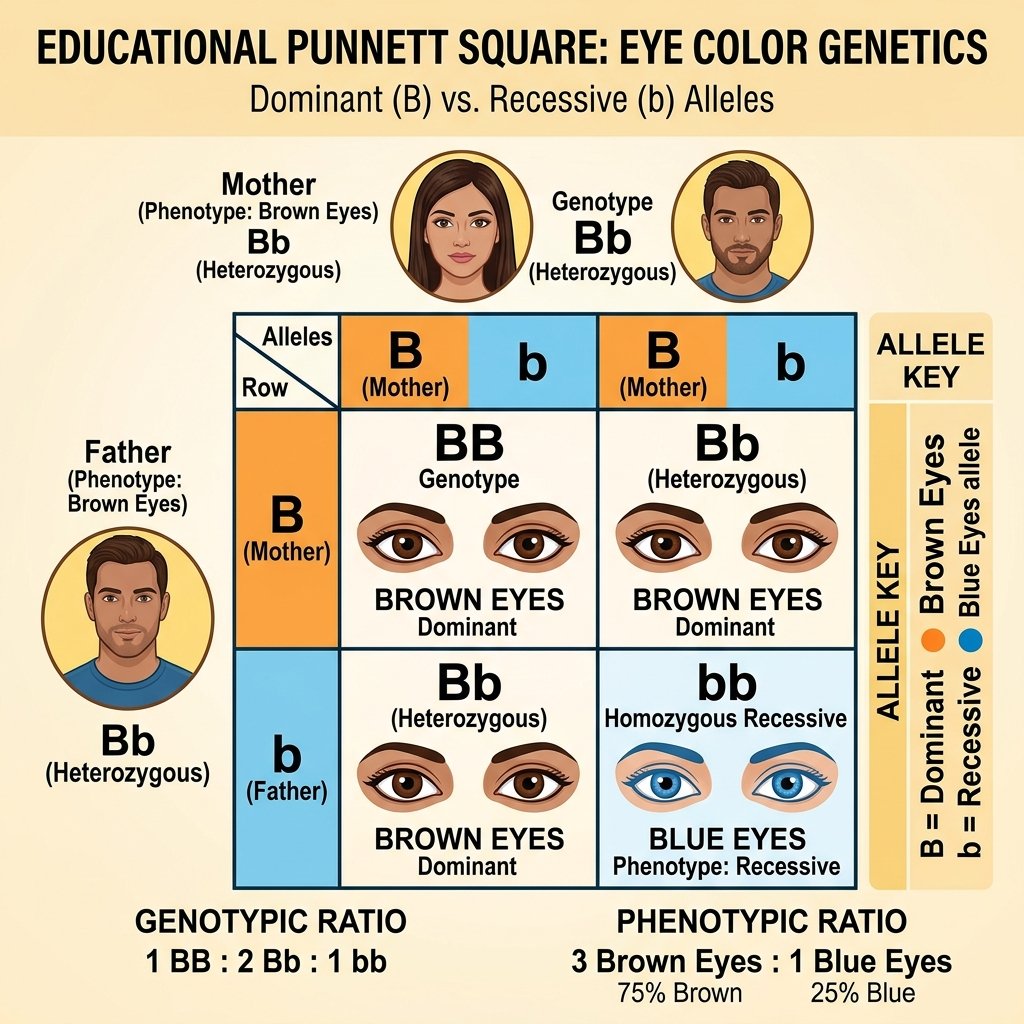
This is where it gets interesting. If both parents have brown eyes but each carries one recessive "blue" allele, there's a 25% chance their child will inherit two blue alleles and have blue eyes.
Here's the breakdown using simple notation (B = brown/dominant, b = blue/recessive):
- Parent 1: Bb (brown eyes, carries blue)
- Parent 2: Bb (brown eyes, carries blue)
Possible combinations for their kids:
- BB → Brown eyes (25%)
- Bb → Brown eyes (50%)
- bb → Blue eyes (25%)
So yes, two brown-eyed parents absolutely can have blue-eyed children—if they both carry the recessive blue allele. This isn't rare at all. It's basic Mendelian genetics at work.
Want to dive deeper into how eye color inheritance actually works with multiple genes? We've got a full guide on that.
Misconceptions About Dominant Traits
Myth #1: Dominant Means "More Common"
Nope. Dominant just means "expressed with one copy." It doesn't mean that trait is more frequent in the population. For example, having a widow's peak (dominant) is actually less common than having a straight hairline (recessive) in many populations.
Myth #2: Dominant Traits Are "Better" or "Stronger"
There's no biological superiority to dominant traits. They're just expressed differently. In fact, some genetic diseases are caused by dominant mutations, which means you only need one bad copy to have the condition.
Myth #3: Recessive Traits Will Eventually Disappear
Not true. Recessive alleles can stick around in populations indefinitely because carriers (people with one recessive and one dominant allele) pass them on without expressing the trait themselves. That's why traits like red hair—which is recessive—still exist despite being rare.
When Traits Don't Follow Simple Rules
Most human traits aren't controlled by a single gene with simple dominant/recessive rules. Instead, they follow more complex patterns:
Incomplete Dominance
Sometimes neither allele is fully dominant, so you get a blend. Hair texture is a good example—curly and straight hair can produce wavy hair in offspring.
Codominance
Both alleles are expressed equally. Blood type is the classic example. If you inherit an A allele from one parent and a B allele from the other, you have type AB blood—both show up.
Polygenic Inheritance
Multiple genes working together determine the trait. This applies to skin tone, height, and most other complex traits. There's no simple dominant/recessive pattern here—it's all about the combined effect of many genes.
Real-World Application: What This Means for You
Understanding dominant and recessive traits can help you:
- Predict possible traits in your future children (though it's never 100% certain)
- Understand why you look different from your siblings despite having the same parents
- Make sense of genetic counseling information if hereditary conditions run in your family
But remember: genetics is rarely black and white. Most traits involve multiple genes, environmental factors, and random variation. The classic "dominant vs recessive" model is a useful starting point, not the whole story.
Carrier Status and Family Planning
Being a carrier for a recessive trait matters most when it comes to genetic conditions. If both you and your partner carry the same recessive mutation (like for cystic fibrosis or sickle cell disease), there's a 25% chance your child will inherit two copies and have the condition.
This is why genetic screening exists. If you're planning a family and have concerns about hereditary conditions, a genetic counselor can help you understand your carrier status and what it means for your kids.
The Bottom Line
Dominant traits are expressed with just one copy of the gene variant, while recessive traits need two copies. But human genetics is far more complex than simple dominant/recessive models suggest. Most traits involve multiple genes, and environmental factors play a role too.
The old "brown eyes always beat blue eyes" rule? It's a simplification. Helpful for understanding basic inheritance, but not the full picture. Real genetics involves carriers, multiple genes, and lots of variation—which is exactly what makes each person unique.